Garden tool aisles can intimidate new gardeners with their endless variety. Most of the tools sold are unnecessary; a small handful does most of the work in any home garden. After several years of using and replacing various tools, we have a clear list of what is genuinely useful.
The eight tools below cover almost everything a sustainable home gardener needs to start. Each one earns its place through years of regular use. Several of them can be bought used for a fraction of new prices; quality matters but new is not always better.
The eight essentials
These tools handle nearly every task a first-year garden requires.
- Hand trowel. The most-used tool in any garden. Buy a quality one with a solid forged or welded blade and a comfortable handle. Avoid hollow plastic-handled versions; they fail within a season.
- Hand pruners (bypass type). For trimming herbs, deadheading flowers, pruning small branches. Buy Felco, Corona, or similar quality brand; they last decades. Hardware-store cheap pruners last a season and tire your hand.
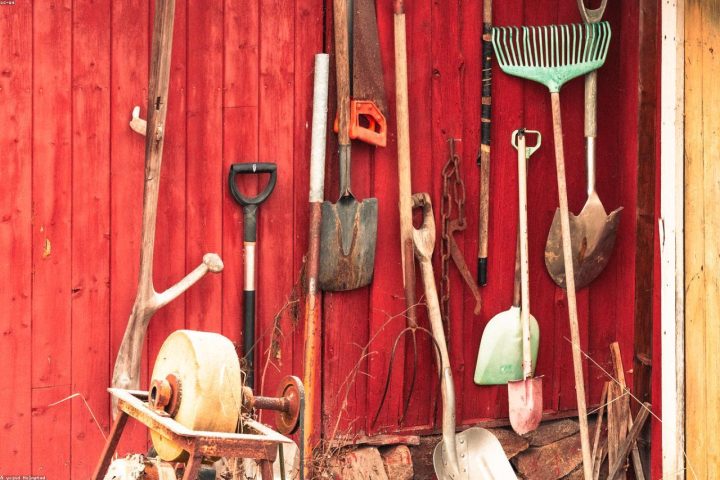
- Garden fork (4-tine). For turning compost, loosening soil, lifting root crops. A long-handled garden fork is more versatile than a digging fork; both work for most tasks.
- Round-point shovel. For planting trees, transplanting, digging holes. A simple wood-handled or fiberglass-handled shovel from a hardware store works fine.
- Long-handled hoe. The most efficient weeding tool. A stirrup hoe (also called “scuffle hoe”) handles small weeds with minimal effort.
- Quality hose. A drinking-water-safe rubber hose lasts decades and resists kinking. Quality matters; cheap hoses kink, split, and need annual replacement.
- Watering can. 2-gallon size for general use. A long thin spout for targeted watering.
- Wheelbarrow or garden cart. For moving mulch, compost, soil, plant material. A two-wheel garden cart is more stable than a traditional wheelbarrow; either works.
Why these specifically
The list above covers an enormous range of garden tasks with overlap rather than redundancy. The hand trowel and hand pruners handle small-scale work. The fork, shovel, and hoe handle medium-scale work. The hose, watering can, and wheelbarrow handle the supporting tasks (water, transport).
Each tool selected here has reasonable cost and long life when chosen well. A quality hand trowel costs $20 and lasts 20+ years. Quality pruners cost $40-$70 and last just as long. A wood-handled fork lasts 30+ years. None of these are budget-busting individually.
Where to buy and what to look for
For each tool, look for quality features that distinguish lasting versions from disposable ones.
Hand trowel: solid metal blade (forged or welded steel), comfortable handle (wood, rubber-grip, or solid plastic). Avoid hollow plastic handles.
Pruners: bypass-style blade (two blades that cross), replaceable parts (Felco pruners can be repaired and sharpened for life), comfortable grip. Anvil-style pruners crush stems rather than cutting cleanly; avoid.
Fork: solid steel tines (not hollow), quality wood or fiberglass handle, secured joint between handle and tines.
Shovel: solid steel blade, quality handle, secured joint. Round-point for general use; square-point for edging.
Hoe: stirrup hoe (sometimes called “Dutch hoe” or “scuffle hoe”) with replaceable blade. Avoid traditional draw hoes for most home garden weeding.
Hose: rubber (not vinyl) construction, drinking-water-safe rating, brass fittings (not plastic). 50 or 75 feet is enough for most small gardens.
Watering can: 2-gallon size, removable rose (sprinkler head) for fine watering. Plastic versions are fine; galvanized metal lasts longer.
Wheelbarrow or cart: 4-6 cubic feet capacity, sturdy steel construction. Test the maneuverability before buying.
Tools you can skip (despite marketing)
Several categories of tool are not needed in a typical home garden.
Specialty hand tools (cultivators with multiple blades, weeding tools with specific shapes). The hand trowel does most of this work; specialty versions add cost without adding much function.
Power tools beyond basics. A small electric tiller (rarely needed for a no-till garden), leaf blower (rake works fine for small areas), hedge trimmer (hand pruners work for occasional pruning).
Tool sets and “starter kits.” These bundle 6-10 tools but the quality of each is typically lower than buying individual tools. Better to buy 3-4 quality tools than 10 cheap ones.
Decorative or “aesthetic” garden tools. Beautiful copper trowels and brass watering cans look lovely but cost 3-5x equivalent functional tools and do not work better.
Gimmicky weeding tools. The “weed twister,” “claw weeder,” and various other specialty weeders solve specific problems but the hand trowel and stirrup hoe handle most weeding well.
Adding to the basics later
Once the eight essentials are in place and you have a year or two of experience, several additions earn their place.
- Broadfork. For loosening compacted soil without tilling. $150-$300; lasts decades. Most useful for new garden establishment.
- Soil knife (hori-hori). A serrated knife for transplanting, dividing, weeding. Once you have one, you use it constantly. $30-$50.
- Loppers. For pruning branches 1/2 to 2 inches in diameter, where pruners are too small. $40-$80.
- Pruning saw. For pruning branches 2+ inches. Folding versions are convenient. $25-$50.
- Hose-end attachments. A spray nozzle, a soaker setup, a watering wand. Each costs $10-$20 and serves specific purposes.
- Garden hod or harvest basket. For carrying harvest. A 3-gallon ventilated basket works well. $30-$50.
- Garden gloves. Multiple pairs of different weights for different tasks. Goatskin for general use; heavy leather for thorny plants; nitrile for wet work.
Tool care that extends life
Basic tool maintenance extends life dramatically. The routine is simple.
Clean after each use. Wipe blades clean of soil with a stiff brush or rag. Major caking soil can be removed by working the tool through dry sand a few times.
Sharpen periodically. A pruner cuts cleanly when sharp; raggedly when dull. Pruners and shovel edges benefit from light sharpening every 3-5 uses. A simple sharpening stone ($5-$10) handles this.
Oil moving parts. Pruner pivot points, fork joints, hose connections all benefit from occasional oil. WD-40 or 3-in-1 oil works fine.
Store properly. Out of weather (a garage or shed); off concrete floors that wick moisture. Hang or stand vertically. Wood handles benefit from occasional linseed oil treatment.
A small set of quality tools handles almost everything a sustainable home garden requires. The eight essentials above provide complete coverage for typical garden tasks. Quality matters more than quantity; better to have eight tools that last for decades than twenty that last for a season. Add specialized tools as specific needs arise; many gardeners find they never need most of what the marketing suggests.
Related reading from the journal
If you found this useful, you may also like A Quiet Hour-Per-Week Gardening Plan, Reading Plant Tags Without Getting Overwhelmed, and Realistic Gardening Habits for Busy Households.
Further reading
Trusted references we consulted while researching this piece. All external.