Cabbage moths ruin brassicas faster than almost any other pest in my beds. By the time you spot the pale green caterpillars, they have already lace-worked half a row of Lacinato kale. Sprays help a little. Hand-picking helps a little more. One properly installed row cover ends the problem for the whole crop cycle.
Why sprays and hand-picking never quite finish the job
Bt (Bacillus thuringiensis, kurstaki strain) kills caterpillars within a day or two of ingestion, and it is genuinely useful as a spot treatment. The problem is that the adult Pieris rapae, the small white butterfly bouncing over your broccoli every warm afternoon, keeps laying single yellow eggs on the undersides of leaves. Miss a week of spraying, or get four days of rain that wash off the Bt, and you are back to a chewed row.
Hand-picking works on a home scale of six plants. On a 40 foot bed of Napa cabbage it is a losing proposition. Each female lays 300 to 400 eggs across her lifespan, and they hatch in 5 to 7 days at 70 to 80 F. You cannot out-pick that math.
A physical barrier is the only intervention I trust to hold a bed through 60 to 100 days of growth. The catch is that most row cover installations fail by week three. Wind gets under an edge, a deer steps on a hoop, and a section sags onto the plants where moths cheerfully lay eggs through the fabric.
The fabric weight that actually survives a season
For brassicas in western North Carolina I use Agribon AG-19 (0.55 oz per square yard, about 85 percent light transmission) or ProtekNet insect netting (0.35 mm mesh) on hot weeks when I need better airflow. AG-15 is too flimsy for anything past spring lettuce. AG-30 or heavier is meant for frost protection and holds too much heat under a June sun.
For a 4 by 30 foot bed, plan on a 10 by 40 foot piece so you have room to bury or weight both long sides plus the ends. A 10 by 50 foot roll of Agribon runs about $45 to $60 from Johnny’s or Dubois. ProtekNet is roughly double that but lasts three to four seasons instead of one or two.
Frames that do not collapse in a thunderstorm
Cheap 1/2 inch PVC bows kink and drop the fabric onto your plants after the first heavy rain, at which point the moths land on the sagging cloth and oviposit directly through it. That single failure mode is why so many gardeners conclude row cover “does not work.”
Use 9 gauge galvanized wire hoops (Johnny’s sells them 76 inches long) or 1/2 inch electrical metallic tubing (EMT) bent with a $30 hoop bender. Both hold shape under 3 inches of wet snow, which we get here in the Blue Ridge foothills at least twice a spring.
Space hoops every 4 to 5 feet along the bed and push each leg 8 to 10 inches into the ground. If your soil is rocky, drive a length of rebar first, pull it out, and slide the hoop leg into the hole.
The edge seal is the whole game
This is the part almost everyone skimps on, and it is the reason a covered bed still ends up with caterpillars. Cabbage whites will find a two inch gap. I have watched them work along the edge of a poorly weighted cover, testing every inch, until they slip under.
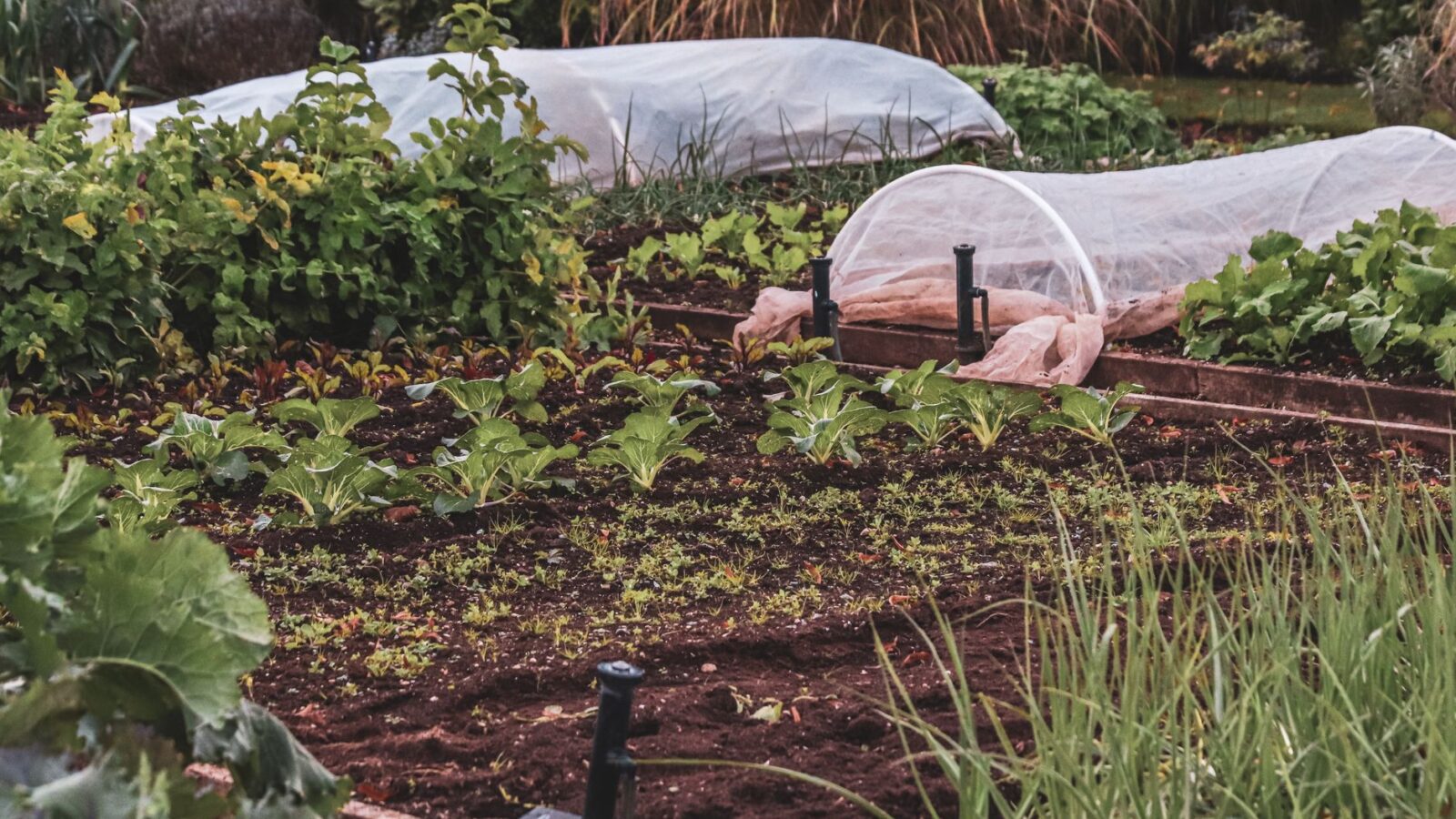
The fabric has to make continuous contact with the soil on all four sides. Three methods that actually seal an edge:
- Sandbags every 3 feet. Fill 12 by 26 inch woven poly bags about two-thirds full (roughly 12 pounds each). They mold to uneven soil better than boards or rocks.
- Six inch landscape staples every 18 inches. Faster to install than sandbags, but they can tear the fabric where wind flexes it. Reinforce staple points with a small strip of Tyvek tape.
- Trenched and buried edge. Best seal, worst on your back. Dig a 3 inch furrow along both long sides, lay the cover into it, and pull the soil back over. I reserve this for beds I know I will not open for four to six weeks.
For the two short ends, gather the fabric like a garbage bag neck and cinch with a bungee looped around a driven stake. Do not weight the ends flat: wind funnels under a loose gather and pops the whole cover.
Timing: cover the bed the day you transplant
Cover goes on the same day the plants go in, before any moths have had a chance to lay eggs on the seedlings. If you started your transplants outdoors uncovered for even two days, inspect every leaf underside for the tiny yellow eggs and rub them off before installing.
I leave covers on brassicas for the entire crop cycle: 60 to 90 days for broccoli, 70 to 100 for cabbage. The parts we eat are not insect pollinated, so pollinator access is not required. Water goes right through AG-19.
Lift the cover once every 10 to 14 days for weeding and to check for aphids, which are not excluded if they were already present in the soil or on transplants. Twenty minutes of work, then close it back up carefully.
A quick condition check before you walk away
| Check | Pass | Fix if fail |
|---|---|---|
| Fabric touching soil on all 4 sides | Continuous contact | Add sandbag or staple |
| Hoop spacing | 4 to 5 ft apart, no sag | Add hoop at midpoint |
| End gathers | Cinched, tied to stake | Re-gather and bungee |
| Fabric to leaf clearance | At least 6 in | Taller hoops needed |
| Visible tears | None over 1 in | Patch with Tyvek tape |
The clearance point matters. If fabric rests on leaves, moths lay eggs through the cloth onto the leaf directly below. I once lost half a row of Tuscan kale to this after a heavy dew flattened AG-19 onto the tops.
What goes wrong, and how to catch it early
Small shot-hole damage inside a covered bed usually means eggs were already on transplants at planting, or a torn edge is letting adults slip in. Lift the cover, spray Bt on both leaf surfaces, hand-pick any caterpillars over 1/4 inch, and close it back up.
White fabric with green frass dots on the underside means the cloth is contacting leaves. Raise the hoops, or add a spacer stake in the middle of each hoop span.
Covers blown 20 feet down the field after a storm means not enough weight on the windward side. Double up sandbags on the prevailing wind edge (west side for most of Appalachia). One 25 pound sandbag every 4 feet holds through 40 mph gusts in my beds.
If you see cabbage looper damage (larger caterpillars, more voracious than cabbage white larvae), a moth got in at night. Loopers are stronger fliers and will exploit smaller gaps. Same fix: seal the edge, tighter this time.
For a deeper primer on the biology of Pieris rapae and monitoring thresholds, the UC IPM cole crops guide is the reference I keep bookmarked.
Frequently asked questions
Can I reuse row cover from season to season?
Agribon AG-19 typically lasts 2 to 3 seasons if you fold it dry and store it in a rodent-proof bin. ProtekNet goes 4 or 5 seasons. Sunlight, not use, is what breaks the fabric down, so leaving it on year round shortens its life faster than reinstalling it each spring.
Do I need to remove the cover for pollination?
Not for brassicas eaten as leaf, head, or floret (cabbage, broccoli, kale, kohlrabi, cauliflower, Brussels sprouts). All are self-pollinating for our purposes or wind pollinated. Only remove covers if you are saving seed.
Will row cover overheat my plants in summer?
AG-19 raises bed temperature 2 to 4 F on sunny days, which is fine for brassicas up to about 85 F ambient. Above that, switch to ProtekNet insect mesh, which adds almost no heat and still excludes cabbage moths, flea beetles, and imported cabbageworm.
What about slugs and aphids under the cover?
The cover does not stop what is already there. Set out iron phosphate slug bait (Sluggo) before you install the fabric, and check transplants for aphid colonies before planting. A covered bed is a warm, still environment where aphids multiply fast if they arrive with the seedlings.
Is Bt safe to spray if I still want to use the cover?
Yes. Bt (kurstaki strain) is a targeted bacterium that affects caterpillars only, breaks down within 3 to 5 days in sunlight, and is approved for certified organic production. Spray in the evening when you lift the cover for weeding, then re-cover the same day.
Further reading
Trusted references we consulted while researching this piece. All external.