Most garden writing assumes the reader has a Saturday morning free. For working households (which is to say, most of us), that assumption breaks down. A garden that takes six hours of weekly maintenance is not maintainable; it becomes a source of stress within a season.
A genuinely low-maintenance garden is not a compromise. With the right design choices upfront, a beautiful garden can be sustained with one to two hours of weekly care across most of the year. We have been refining this approach for years, both in our own garden and in helping friends start theirs. The design principles are the leverage; the plant choices come second.
The principles that make the difference
Six design principles, applied at the start, produce a garden that mostly takes care of itself. Trying to apply them retroactively to an existing high-maintenance garden is much harder.
- Generous mulching. A three-inch mulch layer eliminates ninety percent of weeding. This is the single highest leverage choice.
- Perennials over annuals. Perennials work for years from a single planting. Annuals require planting and replanting yearly.
- Group by water needs. Plants of similar needs grouped together let you water efficiently or not at all.
- Generous spacing. Tight planting requires frequent intervention. Spaced planting fills in gracefully and stays balanced.
- Native and adapted species. Plants suited to your climate need less watering, less feeding, and rarely get sick.
- Hardscape generously. Paths, patios, and decorative ground cover reduce the area requiring active gardening.
A simple front-yard layout
For a typical suburban front yard of perhaps 300-400 square feet:
Central focal point: a small native tree (serviceberry, redbud, or dogwood). Pick one that is reliable in your zone, plant it well in the first autumn, and water it through its first summer. After that, no maintenance required.
Surrounding the tree: a generously sized bed (maybe 12 feet diameter) of drought-tolerant perennials in groups of three to five. Echinacea, black-eyed Susan, sedum, ornamental grasses, lavender. Mulched heavily with wood chips. Maintenance: one annual cut-back in spring, one mid-summer deadheading pass (optional), occasional weeding around the edges.
Remaining lawn area: kept as lawn, or replaced with no-mow groundcover (creeping thyme, white clover blend, native sedge meadow). Lawn substitutes reduce mowing dramatically; even a regular lawn can be cut to mow once every two weeks instead of weekly.
A low-maintenance back-garden layout
For a back yard or larger area:
A perimeter shrub border. Native or naturalized shrubs (viburnum, serviceberry, dwarf hydrangea, ninebark) along the property edges. These need almost no care once established. They define the space, provide privacy, and support birds and pollinators.
A patio or seating area as a central focal point. Hardscape requires no maintenance. A 12-foot square of pavers or gravel is far less work than the same area in lawn or garden beds, and it gives you somewhere to enjoy the rest of the garden.
One or two perennial beds. Six to eight square feet of carefully chosen perennials in mulched beds. This is where you spend most of your active gardening time. Limit the total perennial-bed area to what you can comfortably maintain in two hours per week.
Lawn or groundcover for the rest. A small lawn for foot traffic, with all other spaces converted to mulched paths or low-maintenance groundcovers.
The plant list that does the work
Certain plants are dramatically less maintenance than others. Build your garden around these.
- Ornamental grasses (little bluestem, switchgrass, panicum): cut back once in spring, ignore the rest of the year
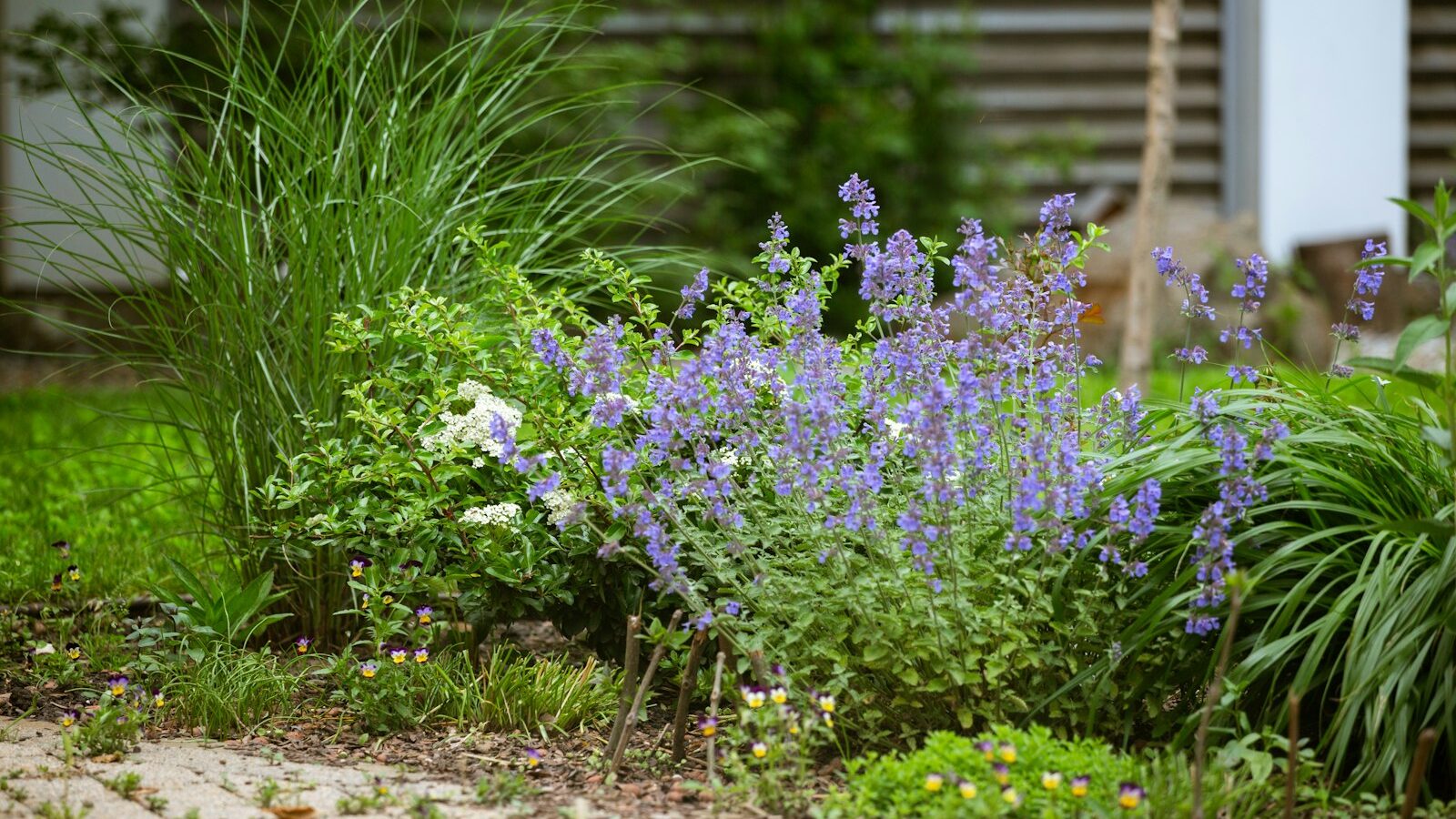
- Catmint: one mid-season shear-back keeps it neat; otherwise zero maintenance
- Sedum: almost no care required, drought-tolerant, attractive year-round
- Russian sage: cut back in spring, blooms all summer with no other intervention
- Lavender: light shearing after bloom, very low water needs
- Echinacea: deadhead is optional; seed heads attract finches in autumn
- Black-eyed Susan: spreads slowly into reliable patches
- Native shrubs (ninebark, viburnum, serviceberry): almost no pruning needed, no spraying
The plants to skip
Several beautiful plants are simply not low-maintenance, no matter how the catalogue describes them. If your time is limited, leave these out of the design.
Roses (most varieties) require regular pruning, watering, and disease management. The rugosa and shrub roses are exceptions.
Annual flowers in beds require replanting every year and constant deadheading. Use them in containers if you want, not in beds.
Lawn turf grass (especially Kentucky bluegrass) requires mowing, watering, fertilizing, weed control, and aerating. Reduce lawn area or shift to mixed species lawns with white clover.
Hedges that need shaping (boxwood balls, formal yew hedges) require multiple yearly shearings. Choose naturally-shaped shrubs instead.
Specialty perennials with specific soil needs (bog plants in dry soil, alpine plants in clay) struggle and require intervention. Match plants to your conditions.
A realistic weekly time budget
A well-designed low-maintenance garden takes roughly the following time across a typical season.
- March-April: 3-4 hours total, one big spring cleanup and mulching session
- May-July: 1-2 hours per week of light maintenance, deadheading, occasional weeding
- August: 30-60 minutes per week, mostly watering containers if you have any
- September-October: 1-2 hours per week, light cleanup, autumn planting of bulbs
- November-February: minimal maintenance, leave perennial stems standing for wildlife
A beautiful garden does not require a weekend. With thoughtful design choices upfront, two hours per week sustains a real garden through most of the year. The key is investing the planning time in the first year rather than the maintenance time every season after.
What “low-maintenance” actually means in year three
The garden design choices made in year one determine the maintenance load in years three and beyond. A garden built thoughtfully reaches a steady state where it largely manages itself; a garden built without these principles requires increasing attention year over year.
A well-designed low-maintenance garden in its third year typically requires:
- Spring cleanup and mulching: 4-6 hours, once per year
- Weekly summer maintenance: 1-2 hours, includes weeding, deadheading, harvesting
- Mid-season touch-ups: 30-60 minutes occasionally for any specific issue
- Autumn cleanup: 3-4 hours, including planting fall bulbs and applying autumn compost
- Winter: essentially zero maintenance beyond observation
Total annual maintenance: approximately 60-80 hours across the year, or just over an hour per week averaged. A garden run this way produces continuous interest and harvest with manageable time commitment.
Compare this with conventional gardens that consume 4-6 hours per week year-round (200-300 hours annually). The low-maintenance approach reduces total time by 60-70 percent while producing equivalent or better visual results. The trade-off is the planning investment at the start; the maintenance benefits compound across years.
Related reading from the journal
Other entries worth your time: Native Plants for the Eastern United States: A Beginner Selection, A Rain Garden for a Suburban Backyard, and Replacing Lawn With Something Worth Looking At.
Further reading
Trusted references we consulted while researching this piece. All external.