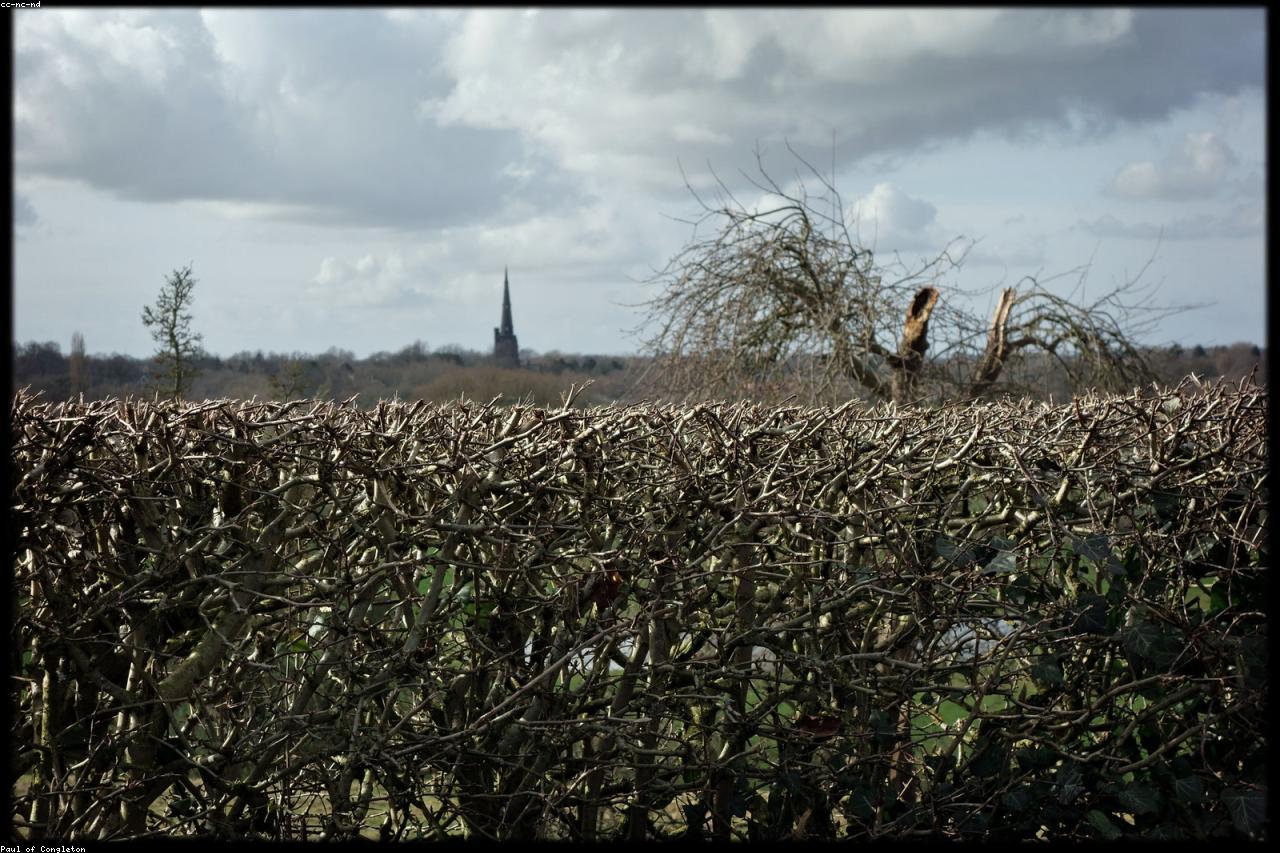
A hedgerow is a mixed planting of shrubs and small trees that historically marked field boundaries across the British and Irish countryside, and still survives in many older European landscapes. It is essentially a linear small forest: a habitat strip rich in birds, insects, and small mammals, and a windbreak besides.
In American suburban landscapes, hedgerows have been replaced by uniform hedges (single-species lines of identical shrubs) or by fences. Both have their uses, but neither approaches what a real hedgerow provides ecologically. The good news: hedgerows scale down to small properties beautifully, and the design is more accessible than it might seem.
What a hedgerow actually is
A traditional hedgerow combines five to fifteen species of native woody plants in a roughly linear arrangement. The plants vary in height, growth habit, fruit production, and bloom time. The mature hedgerow looks like a low forest edge: dense at the base, branching above, with seasonal variation.
The point of mixing species is biodiversity and resilience. A pest or disease that attacks one species does not destroy the entire hedge. Different bloom times feed pollinators across the season. Different fruit types attract different birds. The whole exceeds the sum of its parts.
Hedgerow versus hedge
The distinction matters. A standard hedge is a uniform planting of one species (boxwood, privet, yew) often shaped and clipped to a formal profile. It functions as a wall or boundary marker. It supports very limited biodiversity.
A hedgerow is mixed-species, naturalistic in shape, and functions as an ecological strip in addition to a boundary. It rarely needs clipping. It changes through the seasons. It hosts dramatically more wildlife than an equivalent length of standard hedge.
For most properties, a hedgerow is the better choice for any boundary planting that is not in a strict formal landscape context. The maintenance is less, the ecological value is greater, and the visual interest is higher.
A short list of suitable species
For eastern North America, the following native and naturalized species combine well in mixed hedgerows.
- American hazelnut (Corylus americana): 8-15 ft, produces edible nuts, supports many caterpillar species
- Highbush blueberry (Vaccinium corymbosum): 6-12 ft, edible fruit, autumn color, pollinator value
- Elderberry (Sambucus canadensis): 6-12 ft, edible flowers and fruit, fast growth, supports many bird species
- Serviceberry (Amelanchier canadensis): 15-25 ft, edible fruit, spring flowers, autumn color
- Arrowwood viburnum (Viburnum dentatum): 6-10 ft, white flowers, blue-black berries, native specialty
- Spicebush (Lindera benzoin): 6-12 ft, fragrant foliage, swallowtail butterfly host plant
- Ninebark (Physocarpus opulifolius): 5-10 ft, fast-growing, white flowers, exfoliating bark
- Witch hazel (Hamamelis virginiana): 15-20 ft, late-autumn yellow flowers
- Black chokeberry (Aronia melanocarpa): 3-6 ft, edible fruit, low maintenance
- Winterberry holly (Ilex verticillata): 6-10 ft, brilliant red berries persist through winter
Design for a 40-foot hedgerow
For a typical small-property boundary of 40 feet:
Plant 6-8 different species, with multiple plants of each. A 40-foot length supports roughly 12-16 individual plants spaced about 3 feet apart (which is closer than nursery recommendations, but hedgerows densify into a connected mass over time).
Vary the heights deliberately. Mix tall species (serviceberry, witch hazel) with medium (viburnum, ninebark, elderberry) and lower (chokeberry, low blueberry). The variation creates a layered profile that is much more habitat-rich than a uniform-height line.
Group species in clusters of 2-3 rather than singles. This looks more natural than alternating single specimens and is closer to how plants would establish in a wild edge.
Plant in autumn or early spring. Water deeply for the first two summers. Mulch heavily to suppress weeds while plants establish. By year three, the hedgerow has begun to function as a connected mass.
Maintenance over time
Mature hedgerows need surprisingly little maintenance. The annual routine is usually:
- Late winter: remove dead branches, light pruning of any species that has grown too aggressively
- Spring: top up mulch as needed, water during dry spells in establishment years
- Autumn: watch for ripening fruit (your free bird feed); leave standing for wildlife
- Every 5-7 years: heavier renewal pruning if any species has gotten leggy or overgrown
When hedgerows do not suit
Hedgerows are not the right choice for every situation. They take 3-5 years to look established. They are wider than formal hedges (typically 4-6 feet at maturity). They are less precise; you cannot achieve a rigid clipped profile with mixed-species plantings.
For situations requiring strict formality (a designed front entry, a property line where neighbors expect a rigid boundary), a traditional hedge is more appropriate. For everywhere else, a hedgerow offers more.
A mixed hedgerow on a small property is a quiet revolution. It replaces a fence with a habitat, a boundary with a destination, a single-species wall with a small biological community. The initial planting is the only meaningful work; after that, the hedgerow mostly takes care of itself and provides decades of ecological value. We wish we had planted ours sooner.
A note on installing in clay or rocky soil
Most of our hedgerow installations have been in heavy red clay typical of Appalachian soils. Several species on the list handle this surprisingly well: ninebark, elderberry, spicebush, and witch hazel all establish in clay without amendment as long as drainage is adequate. The exception is highbush blueberry, which requires acidic, well-drained, organic-rich conditions and will sulk in clay no matter what you do for it.
If your hedgerow site has rocks (also common in our area), do not try to remove them. Plant between and around them. The roots find their own way down. A hedgerow installed in stoney clay can establish slightly slower than the same plants in loam, but by year five the difference is invisible. The plants adapt.
One installation tip we always give: when digging holes in compacted clay, score the sides of each hole with a shovel before planting. Smooth clay walls can seal over and prevent root penetration outward. Rough textured walls invite roots to extend into the surrounding soil rather than circling the planting hole.
Related reading from the journal
Other entries worth your time: Low-Maintenance Garden Layouts for Working Households, Native Plants for the Eastern United States: A Beginner Selection, and A Rain Garden for a Suburban Backyard.
Further reading
Trusted references we consulted while researching this piece. All external.